

Globally Mobile Employee Management Guide: Strategies for Success in 2026
Expatriate management in 2026 demands insight and mastery Explore refined strategies trends and support systems to elevate your global workforce with confidence
The pace of global change has never been more breathtaking. In 2026, organizations recognize that mastering expatriate management is not just a competitive edge, but a necessity for thriving across borders.
As international markets shift and regulations grow more complex, leaders must navigate a labyrinth of cultural, economic, and operational challenges. This guide opens the door to the essentials, trends, and actionable steps for success.
Are you ready to discover proven strategies, avoid common pitfalls, and unlock the full potential of your global talent? Step inside for expert guidance on the future of expatriate management.
Understanding Expatriate Management in 2026
The landscape of expatriate management in 2026 feels both exhilarating and intricate. As organizations stretch across continents, the need for a refined approach has never been greater. Picture a tapestry woven from cultures, ambitions, and regulatory threads—this is the art and science of managing expatriates today.
Defining Expatriate Management
Expatriate management is the orchestration of international assignments, guiding employees through transitions between countries and cultures. It involves supporting expatriates—employees working outside their home country—while differentiating them from local hires and third-culture employees, who blend multiple cultural backgrounds.
Type | Definition | Common Roles |
|---|---|---|
Expatriate | Employee on assignment abroad | HR, Global Mobility, Line Managers |
Local | Hired within the destination country | Local HR, Supervisors |
Third-Culture Employee | Raised in cultures different from parents’ origins | HR, Diversity Officers |
Strategic expatriate management empowers multinational companies to bridge talent gaps, accelerate growth, and foster innovation. Asia now leads both outbound and inbound flows, making this region a prime example of dynamic cross-border movement.
Key Trends Shaping Expatriate Management
The world of expatriate management is transforming. Virtual assignments and hybrid work are becoming standard, offering flexibility and speed. Assignment types are diversifying, from short-term stints to local-plus models that blend global and local benefits.
Compensation boundaries are blurring, with local and expat packages converging. The demand for rapid deployment and agile talent solutions rises as companies chase new markets. Notably, emerging markets experience high turnover and double-digit salary growth, according to Mercer.
Virtual assignments and hybrid roles
Short-term, long-term, and local-plus assignments
Local and expat compensation blending
Quick deployment and flexible talent pools
To stay ahead, organizations must keep pace with these global mobility trends in 2026. Understanding these shifts is essential for effective expatriate management.
The Business Case for Effective Expatriate Programs
Why invest in expatriate management? The answer is clear: it shapes talent acquisition, boosts retention, and secures global competitiveness. A thoughtful cost-benefit analysis reveals that the right investments yield substantial returns, not just in financial metrics but in organizational learning and innovation.
Attract and retain top global talent
Strengthen employer branding
Unlock new markets and business potential
Success stories from Asia and Europe abound, where companies with robust expatriate management programs win the race for talent. Employer branding plays a pivotal role, magnetizing high-caliber professionals seeking international opportunities.
Common Challenges in Expatriate Management
Despite the promise, expatriate management is not without obstacles. Navigating complex compliance across borders requires vigilance. Cultural adaptation and integration can test even the most seasoned assignee.
Assignment failure remains a risk, often stemming from unmet expectations or insufficient support. Repatriation brings its own costs, especially in hardship destinations found throughout Asia, as highlighted by Mercer.
Challenge | Impact |
|---|---|
Compliance Complexity | Legal, tax, and regulatory risks |
Cultural Adaptation | Integration hurdles, reduced productivity |
Assignment Failure | Financial loss, talent attrition |
Repatriation Costs | Loss of investment, disengaged returnees |
Anticipating and addressing these challenges is the hallmark of exceptional expatriate management. With insight and intention, organizations can turn complexity into opportunity.
Step-by-Step Expatriate Assignment Life-cycle
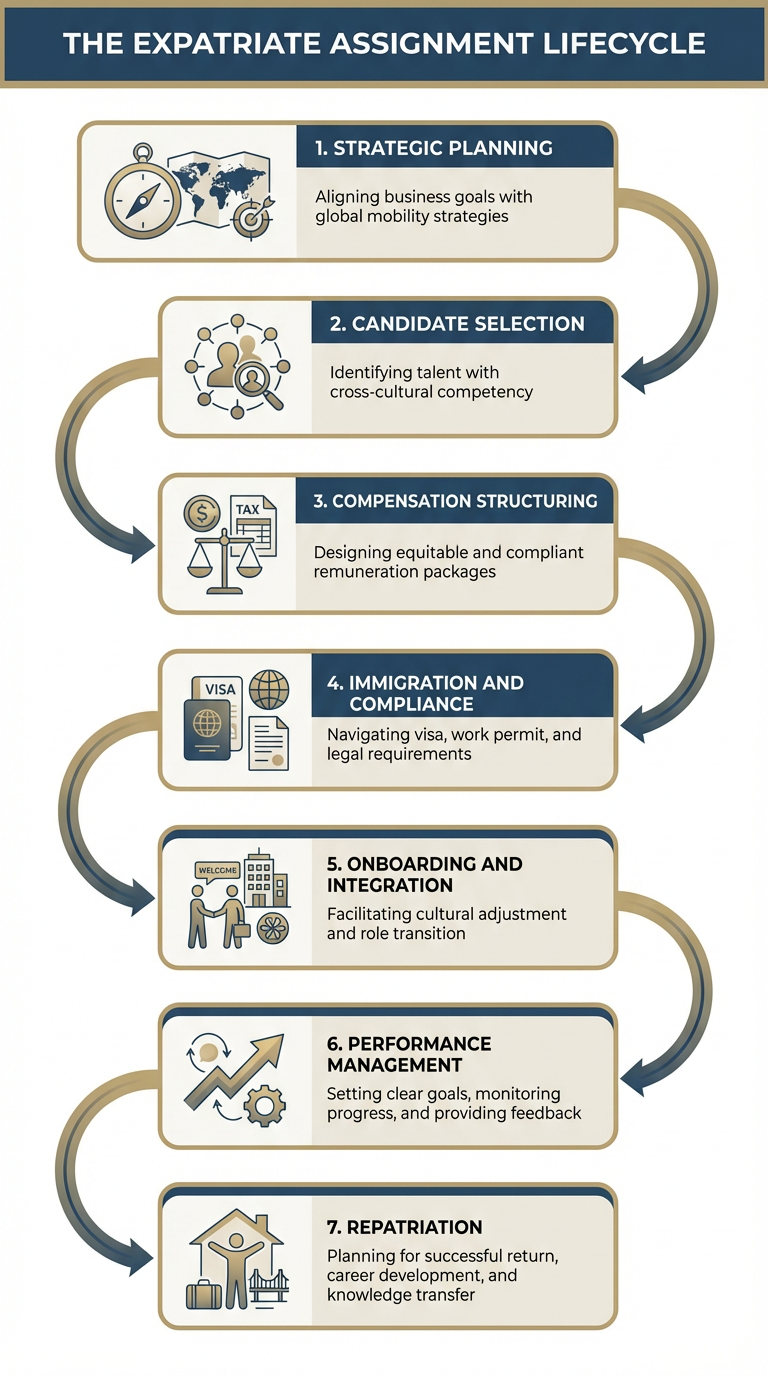
Navigating the expatriate assignment lifecycle is a journey rich with nuance, requiring careful orchestration at every stage. Expatriate management in 2026 is not simply about moving people across borders. It is about aligning strategy, talent, and support to unlock the full promise of global mobility.
Step 1: Strategic Planning & Needs Assessment
Every successful expatriate management journey begins with intentional planning. Organizations must first clarify their business objectives for each assignment. Are you entering a new market, transferring knowledge, or building leadership?
Workforce planning is next. Segment your talent pool to identify who is best suited for global roles. Evaluate which markets align with your goals, considering growth rates, regulatory climates, and local competition.
Salary benchmarking is essential. Platforms like TopSource provide real-time data, ensuring compensation is competitive. For example, when expanding into Asia, skills mapping helps pinpoint gaps and informs both recruitment and training. At this stage, expatriate management is about laying a foundation for success, setting the tone for the entire assignment lifecycle.
Step 2: Candidate Selection and Preparation
Selecting the right candidate is as much art as science. Expatriate management thrives when candidates are evaluated for technical expertise, adaptability, and family readiness. Assessing soft skills and resilience is vital, as the journey can be both challenging and transformative.
Comprehensive pre-assignment preparation is non-negotiable. Language training, cultural immersion, and compliance briefings equip employees for the realities ahead. Family considerations—such as schooling and partner employment—are critical for assignment stability.
For those considering their first international move, the Thinking of moving abroad guide provides invaluable insights on preparation, helping individuals and organizations lay the groundwork for a successful transition. High turnover among new hires in Asia highlights the need for robust support during this phase, underscoring the value of thoughtful expatriate management.
Step 3: Compensation and Benefits Structuring
Compensation is more than just numbers—it is a balancing act between fairness, motivation, and market realities. Expatriate management requires selecting the right model: balance sheet, local-plus, or pure local.
Model | Description | Typical Use Case |
|---|---|---|
Balance Sheet | Home-country base plus allowances | Traditional expats |
Local-plus | Local salary with select perks | Regional/local hires |
Pure Local | Full local market package | Permanent transfers |
Allowances for housing, education, and hardship are tailored to assignment location. Trends in 2026 show a shift: housing allowances now reflect actual hardship levels, and luxury accommodations are less common. For instance, housing in Hong Kong can exceed $10,000 per month, making precise benchmarking a necessity. Effective expatriate management ensures compensation remains both competitive and equitable.
Step 4: Immigration, Tax, and Compliance Management
With borders tightening and regulations evolving, compliance is a pillar of expatriate management. Visa and work permit processes are increasingly complex, often requiring collaboration with local authorities.
Navigating international tax rules demands expertise. Double taxation agreements, tax equalization policies, and social security contributions need careful coordination. Global payroll solutions, such as those from TopSource, help organizations manage these intricacies across multiple jurisdictions.
A misstep in contractor classification or benefits coordination can be costly. Staying vigilant here is crucial—expatriate management is as much about risk mitigation as it is about opportunity.
Step 5: Onboarding and Integration Support
The first weeks abroad can set the tone for the entire assignment. Expatriate management shines when organizations provide seamless relocation logistics, from housing to schooling and healthcare.
Cultural adaptation programs, local networking opportunities, and mentorship foster belonging. Family support—whether for children’s education, partner employment, or eldercare—directly impacts assignment success. Mercer data shows that family issues are a leading barrier for Asian outbound assignees. A holistic support strategy is therefore essential to expatriate management, nurturing resilience and engagement from day one.

Step 6: Performance Management and Development
Sustained success abroad requires more than initial preparation. Expatriate management involves setting clear goals and KPIs, holding regular performance reviews, and mapping out career development.
Continuous feedback keeps employees motivated and aligned with organizational objectives. Training and development opportunities ensure skills remain sharp and relevant. In Asia, frequent promotions and title expansions are common, reflecting the importance of visible growth. Expatriate management must embrace a culture of learning and recognition, turning assignments into stepping stones for global leadership.
Step 7: Repatriation and Retention Strategies
The journey home is as important as the journey out. Expatriate management calls for early, intentional repatriation planning. Career path mapping, reintegration programs, and expectation management help returning employees leverage their international experience.
Organizations risk losing top talent to global competitors if repatriation is mishandled. Mercer highlights that many assignees are tempted by external offers post-assignment. A robust expatriate management strategy ensures knowledge transfer, retention, and a sense of belonging, transforming global experience into organizational advantage.
Navigating Compliance and Risk in International Assignments
In the world of expatriate management, compliance and risk are evolving landscapes that demand both vigilance and agility. As organizations expand globally, the stakes grow higher, making it essential to navigate these complexities with confidence and care.
Global Employment Law and Regulatory Trends
Global employment law in 2026 is a tapestry of shifting regulations, digital mandates, and heightened scrutiny. Multinational companies must address cross-border contracts, local labor laws, and the growing influence of data privacy. Regulations now address not only traditional employment but also remote work and digital compliance, requiring HR teams to stay ahead of the curve.
Staying informed is crucial, as regulatory fragmentation and technological advances create new challenges. For a deeper understanding of these evolving issues, explore the global compliance concerns for 2026 impacting expatriate management worldwide.
The right strategies allow organizations to maintain compliance while supporting business goals. This is where proactive expatriate management becomes a true differentiator.
Taxation, Social Security, and Payroll Complexities
Taxation and social security are core pillars of expatriate management. Double taxation risks, tax equalization policies, and social security contributions vary by country, requiring meticulous planning. Payroll complexities multiply with multi-country assignments, as local laws and reporting standards shift.
Consider this summary table for clarity:
Issue | Challenge | Solution |
|---|---|---|
Double Taxation | Overlapping tax liabilities | Tax equalization agreements |
Social Security | Varied contributions | Bilateral agreements |
Global Payroll | Compliance across borders | Centralized payroll systems |
Staying compliant means investing in global payroll solutions and expert advisory. These safeguards ensure expatriate management delivers both compliance and value.
Immigration and Work Permit Challenges
Immigration is a dynamic frontier in expatriate management. Visa requirements, work permit quotas, and shifting geopolitical climates all shape assignment feasibility. Regulatory changes in Asia, for example, have introduced complex approval processes and increased scrutiny.
Organizations must remain agile, adapting to new legislation and processing times. Navigating this landscape requires robust planning and the ability to respond quickly to policy changes. Effective expatriate management hinges on anticipating and addressing these challenges before they impact global mobility.
Contractor vs. Employee Classification Risks
The distinction between employees, contractors, and freelancers is more nuanced than ever in expatriate management. Misclassification can result in legal, financial, and reputational risks, especially as remote and hybrid work expand.
Key considerations include:
Defining employment status clearly in contracts
Auditing roles regularly for compliance
Leveraging third-party solutions for classification clarity
A proactive approach, rooted in strong expatriate management, mitigates risks and ensures seamless cross-border assignments.
Managing Assignment Failure and Duty of Care
Assignment failure is a costly risk in expatriate management, often stemming from poor integration, compliance lapses, or family challenges. Duty of care obligations require organizations to safeguard the health, safety, and security of their assignees.
Best practices include:
Comprehensive pre-departure orientation
Responsive health and security support
Crisis and contingency planning
By weaving these elements into every stage of expatriate management, organizations foster resilience and protect both their talent and reputation.
Building a Supportive Expatriate Ecosystem
Creating a nurturing ecosystem is essential to successful expatriate management. When organizations invest in robust support systems, they empower globally mobile talent to flourish, adapt, and thrive in unfamiliar environments.
Comprehensive Support Systems for Expatriates
A holistic approach to expatriate management starts with comprehensive support for both assignees and their families. This includes relocation services that streamline the move, housing assistance, and guidance on schooling and healthcare. Digital platforms now provide ongoing support, connecting expatriates to resources and communities in real time.
Key elements include:
Relocation logistics and settling-in services
Access to quality housing and educational options
Healthcare navigation and insurance support
By integrating these services, organizations create a foundation of stability, allowing talent to focus on their assignments and maximize the value of expatriate management.
Fostering Cross-Cultural Adaptation and Inclusion
Cross-cultural intelligence is a vital thread in the tapestry of expatriate management. Cultural training, mentorship, and building inclusive teams across borders foster understanding and collaboration. When Western and Asian management styles blend, for example, teams unlock powerful synergies.
Effective programs often feature:
Cultural intelligence workshops
Peer mentorship and buddy systems
Opportunities for local immersion
For deeper insight into nurturing cross-cultural skills, explore building cross-cultural intelligence and how it shapes successful expatriate management. These initiatives lay the groundwork for a truly global mindset.
Mental Health, Wellbeing, and Social Integration
The emotional landscape of expatriate management is as complex as it is profound. Addressing isolation, stress, and culture shock is crucial for wellbeing. Organizations can offer access to counseling, peer support networks, and community events that foster belonging.
Consider these supportive measures:
Confidential counseling services
Social gatherings and family-friendly activities
Peer support groups for shared experiences
A resilient expatriate, grounded in mental wellbeing, is better equipped to navigate the challenges and opportunities of international life, enhancing the overall success of expatriate management.
Leveraging Expatriate Networks and Communities
Networks are the lifeblood of expatriate management, offering a bridge between cultures and a wellspring of local knowledge. Professional and social connections abroad open doors, spark innovation, and support retention.
Benefits of strong networks include:
Access to local insights and best practices
Knowledge sharing among peers
Enhanced retention through community belonging
Peer networking is a proven retention tool, helping organizations realize the full potential of their global talent through strategic expatriate management.
House of Peregrine: Empowering Expatriate Success
House of Peregrine stands as a beacon in the world of expatriate management, offering a global community and curated resources for expatriates and global nomads. Members benefit from expert advice, immersive events, and practical guides on relationships, finances, and cultural adaptation.

This ecosystem transforms shared wisdom into actionable solutions, fostering a sense of belonging and connection. Tailored for individuals and families navigating international transitions, House of Peregrine helps them thrive, not just survive. As a partner, it serves organizations seeking holistic support for their mobile workforce, elevating the impact of expatriate management.
Future-Proofing Expatriate Management: Strategies for 2026 and Beyond
The future of expatriate management is unfolding with breathtaking speed. As 2026 approaches, organizations must weave foresight, adaptability, and innovation into every aspect of their global mobility programs. Mastering expatriate management now means not only keeping pace with change but also anticipating the next wave of transformation. Let us explore the essential strategies that will define success for global leaders and their mobile talent in the years ahead.
Embracing Technology and Digital Transformation
Technology is the golden thread connecting the new era of expatriate management. Modern HR platforms now automate compliance, payroll, and reporting, reducing complexity and freeing HR teams to focus on strategy. Digital dashboards provide real-time insights into assignment progress, costs, and risk.
Mobility management platforms streamline processes, making it easier to track expat performance and well-being. Virtual assignments and remote work solutions are no longer futuristic—they are standard practice. As organizations embrace these tools, they unlock agility and resilience in expatriate management.
Staying current with HR compliance trends for 2026 ensures that technology adoption aligns with evolving regulatory demands. This digital transformation fosters a seamless, connected experience for both HR and globally mobile employees.
Adapting to Evolving Talent Markets and Assignment Types
The landscape of expatriate management is shifting rapidly, shaped by new assignment types and dynamic talent markets. Short-term, project-based, and virtual assignments are rising in prominence, offering flexibility for both employers and employees.
Organizations are moving away from traditional expat packages, favoring local-plus and hybrid compensation models. In Asia, for example, the shift toward localized arrangements reflects a broader trend toward cost efficiency and talent retention.
Understanding global talent trends for 2026 is essential for HR leaders navigating these changes. By monitoring workforce shifts, companies can ensure their expatriate management strategies remain relevant and competitive in a fluid market.
Enhancing Employer Branding and Employee Experience
Aspirational employer branding is at the heart of successful expatriate management. Organizations that present themselves as destinations of choice for global talent attract and retain the best and brightest.
Personalizing the expatriate journey elevates engagement and loyalty. This includes tailoring onboarding experiences, supporting family integration, and fostering community involvement in host locations. When employees feel seen and valued, their sense of belonging deepens.
Promoting local integration and creating opportunities for meaningful connection transform assignments from mere relocations into enriching life chapters. Exceptional expatriate management turns global moves into lasting partnerships between talent and organization.
Diversity, Equity, and Inclusion in Global Mobility
True excellence in expatriate management is rooted in diversity, equity, and inclusion. Expanding opportunities for underrepresented groups strengthens organizational culture and drives innovation.
HR leaders must address barriers such as cultural norms or the so-called “bamboo ceiling” in Asian firms. Offering mentorship, transparent selection processes, and accessible support systems opens doors for all.
Inclusive global mobility programs foster a sense of belonging, encourage new perspectives, and help organizations reflect the diversity of the markets they serve. This commitment is not only ethical but also essential for sustaining relevance in an interconnected world.
Strategic Partnerships and Outsourcing Solutions
Strategic partnerships are the backbone of resilient expatriate management. Leveraging external expertise—such as Employer of Record (EOR) services, payroll providers, relocation specialists, and advisory consultants—brings specialized knowledge and operational efficiency.
Outsourcing critical processes reduces administrative burden, mitigates compliance risks, and delivers cost savings. Collaborating with local partners unlocks market insights and smooths the path for assignees.
A well-chosen network of partners transforms expatriate management from a solo journey into a symphony of support, ensuring every move is underpinned by excellence and care.
Measuring Success and Continuous Improvement
Sophisticated expatriate management requires rigorous measurement and a commitment to continuous improvement. Key metrics include assignment success rates, retention, return on investment, and employee satisfaction.
Benchmarking policies and practices against industry leaders uncovers areas for enhancement. Agile feedback loops allow HR teams to adapt programs quickly in response to emerging needs.
By fostering a culture of learning and refinement, organizations ensure their expatriate management strategies remain forward-thinking, effective, and aligned with business goals.
Anticipating Emerging Risks and Opportunities
The horizon is alive with both promise and uncertainty. Geopolitical shifts, mobility restrictions, and changing ESG expectations demand vigilance. Flexible policies and scenario planning equip organizations to navigate disruption and seize new opportunities.
Environmental concerns and social responsibility are increasingly woven into expatriate management decisions. Companies must stay alert to evolving regulations and talent preferences.
Creative solutions are essential for hardship locations, as highlighted in recent Mercer research. By embracing a proactive, opportunity-driven mindset, leaders can transform risk into advantage and ensure their expatriate management programs are truly future-proof.
As you reflect on the evolving landscape of expatriate management and the possibilities that await in 2026, imagine how much richer your journey could be when you’re surrounded by a community that truly understands the art of living abroad. You don’t have to navigate these transitions alone—we’re all explorers at heart, seeking connection, belonging, and a touch of inspiration along the way. If you’re ready to step into a global circle of thinkers, creators, and visionaries, House of Peregrine is the network for International life, created by and for people living abroad. Get started with a FREE account today to unlock exclusive content, connections, and opportunities: Join a global circle of thinkers, creators, and doers. We host events, build products, publish guides, run a podcast, offer rewards and curated products — all within a vibrant ecosystem of experts and businesses to support your life abroad.