
Some conversations help you zoom out—and then somehow bring you back down to earth with more clarity. This one is exactly that.
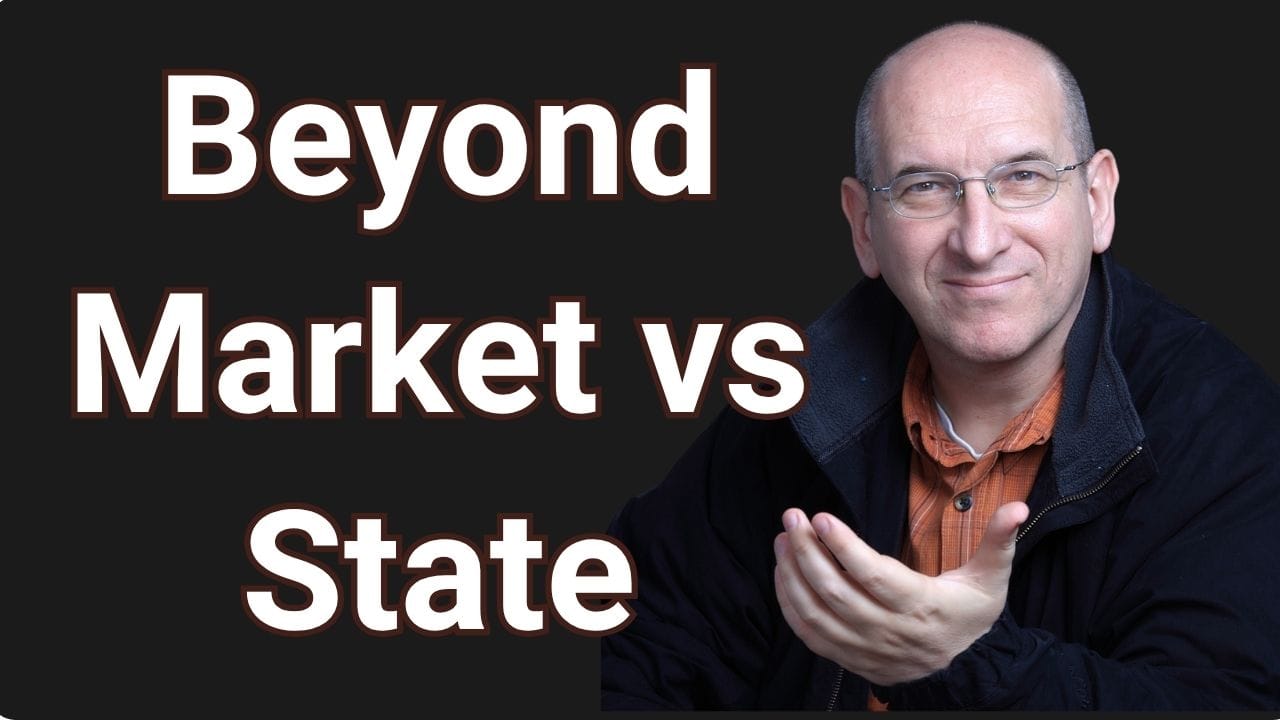
Mickelle sits down with Michel Bauwens, founder of the P2P Foundation, to explore what happens when the dominant systems we’ve inherited—markets and nation-states—start failing to match the world we’re actually living in. Michel’s work has long tracked a core shift: the internet didn’t just connect us socially, it enabled something historically new—translocal self-organization. People coordinating across borders in real time, building shared resources, and creating value outside the usual institutional gatekeeping.
For Peregrines—people living between worlds—this lands in a very real place. Because life abroad reveals the mismatch clearly: your body lives locally (visas, school systems, healthcare, community needs), but your mind, work, relationships, and networks often live globally. Michel offers a framework that names this reality and gives it structure: cosmo-local—keep what’s heavy grounded and local, and let what’s light (knowledge, code, design, learning) move freely and be shared.
But this isn’t techno-utopian. A central thread of the conversation is that technology without relational infrastructure doesn’t hold. Crypto and DAOs experimented with coordination and “trustless” systems, but humans don’t actually thrive without belonging, culture, and solidarity—especially once families, illness, aging, and real life enter the picture. The episode becomes a meditation on what it means to build systems that are not only efficient, but human.
In this episode
- Why “more market vs. more state” is an outdated debate and why Michel believes a third force is emerging
- The shift from commodity value to contributory value (open source, commons-based production, and DAOs as new coordination tools)
- Cosmo-local as a practical worldview: localize what’s resource-heavy; share what’s knowledge-based
- Belonging as infrastructure: modern systems create atomization and new networks must heal it
- Power, dominance, and difference: why equality doesn’t mean sameness, and why context matters
- AI’s double edge: a powerful synthesis engine, and potentially an interface for understanding ecological needs
The big idea: a “third force” is forming
Michel frames this moment as a civilizational transition, not just a political cycle. Markets and states have been competing for centuries, but he argues neither has been able to deliver true regeneration at scale. Meanwhile, open source communities and commons-based ecosystems are already demonstrating another logic: value emerges through contribution.
In a contributory system, people coordinate around shared purpose, visible needs, and voluntary participation—then markets become derivative of the commons, not the center of everything. It’s a reversal that quietly changes how we think about work, status, ownership, and sustainability.
Why this matters to life abroad (and to House of Peregrine)
Mickelle brings the conversation into lived experience: global mobility creates a “missing middle layer.” The internet is too vast, and local meetups often aren’t sturdy enough to become culture. Yet internationally mobile people—especially those settled abroad—need something more nourishing: a way to exchange value, build projects, and create continuity across places.
Michel names the deeper need underneath all of it: repairing atomization. Civilization scaled us beyond the tribe, but it came with a cost—loneliness, disconnection, and systems that don’t feel like they were built for humans with real lives. The work ahead is building networks that can hold both freedom and responsibility—connection and structure.
Cosmo-local: a blueprint for a new world order
Michel breaks cosmo-local down as more than a vibe, it’s a practical way to organize society:
- Relocalization: our current global supply chains are ecologically incompatible with long-term survival
- Bioregionalism: regenerative systems work in complementary clusters (food, energy, housing, transport)
- The national layer still matters: history, culture, and governance don’t disappear—but can support bioregional resilience
- Cosmo-local guilds: people doing similar work globally learning from each other in real time (permaculture with permaculture, builders with builders, caregivers with caregivers)
This is the architecture of a world where knowledge travels, but life is rooted.
A grounded view of AI
Michel closes with a perspective on AI that’s refreshingly specific. He sees two major uses:
- A universal synthesizing machine—helping humans process the overwhelm of our own information production.
- An interface with nature—tools that can help make the “more-than-human” world legible: the needs of ecosystems, species, and the living systems we depend on.
Not domination. Not replacement. But relationship—if we choose it.
About the guest: Michel Bauwens
Michel Bauwens is the founder of the P2P Foundation, an observatory and advocacy hub dedicated to peer-to-peer dynamics, commons-based production, and emerging models of value and governance. He has spent decades tracking how humans self-organize—especially in moments when old institutions strain and new systems begin to form beneath the surface.
Resources from Michel:
- Michel’s Substack (recommended read):https://4thgenerationcivilization.substack.com/p/the-great-entropy-debate-why-the
- P2P Foundation Wiki (recent changes):https://wiki.p2pfoundation.net/Special:RecentChanges Michel says, “Our wiki has 40,000 articles detailed the practices by p2p and commons-oriented communities in every area of human endeavour. If you are interested in societal transitions, you will find the lessons of the pioneers, i.e. about what has worked, or not, the last 15 years.”
Share the episode
If this conversation sparked something, share it with a Peregrine who’s building a life between worlds, and come join us where the local meets the global.